
FREE DOWNLOAD
Want to keep your villa water tank clean and on schedule?
Download our free printable Villa Water Tank Cleaning Checklist and use it to track your six-monthly cleaning, check for warning signs, and confirm your cleaning company is DM-approved.
Read a few tank-cleaning guides and the numbers won’t match. Here’s how the common claims hold up against what DM, Gulf News and health agencies actually say.
| You’ll hear | What the sources say | Verdict |
|---|---|---|
| “Once a year is enough.” | DM’s March 2025 advice says at least every six months (DM). Gulf News reports the Food Code 2020 as twice a year Some older guides still say yearly. | Out of date |
| “DM requires it and fines you AED 500–2,000.” | DM’s wording for homes is advice (“residents are advised”). We found no published fine for private villa tanks. | Unverified |
| “Clear water means a clean tank.” | Some bacteria give off no smell and cause no visible change | False |
| “You catch Legionnaires’ disease by drinking tank water.” | You catch it by breathing in tiny water droplets, from a shower | Misunderstood |
| “A dirty tank explains your hair fall.” | A hair specialist told The National tap water can’t cause hair loss, and chlorine can dry skin and hair. A contaminated tank can add irritants. | Overstated |
| “Once it looks clean, the job is done.” | Gulf News reports that water samples should be tested by an approved laboratory afterwards. You should also get a certificate. | Incomplete |
| “Any cleaning company will do.” | The work is required to be done by companies holding a valid DM licence | False |
| “The landlord always pays.” | DM guidelines, as Gulf News reports them, hold landlords accountable. Some contractors say the owner or tenant must arrange it. Your tenancy contract decides. | Depends |
| “Brown water after summer means a supply problem.” | Dubizzle links brown or yellow water to sediment, rust or dirt inside the tank (Dubizzle). Run the taps first, then check the tank and pipes if it persists. | Check your tank first |
Every six months.
Dubai Municipality (DM) tells residents to clean and disinfect their water tanks and plumbing at least every six months, using DM-approved companies (DM, March 2025). The Food Code 2020 guidance, as Gulf News reports it, says the same thing: at least twice a year, followed by a water test at an approved laboratory.
Here’s how to adjust the schedule to your situation:
| Your situation | Clean | Why |
|---|---|---|
| Occupied villa, normal use | Every 6 months | DM’s baseline advice |
| Villa empty for several weeks (summer travel) | On or just before you return, plus your normal cycle | The same water sat still the whole time, and Legionella grows in stagnant water between about 20°C and 45°C |
| Tank unused for a month or more | Add a clean to your checklist | Stagnant water carries a high contamination risk |
| New or newly handed-over villa | Before you move in | Water may have stood since construction. One reported Palm Jumeirah case traced contamination to a cracked tank and a rusted paint drum left by builders |
| Rented villa, no cleaning record | Ask your landlord now; clean if there’s no certificate from the last 6 months | DM guidelines hold landlords accountable for tank cleanliness |
| Cloudy, smelly or brown water | Immediately | Treat any change as a warning, then return to the 6-month cycle |
| After heavy rain or flooding | Follow your building’s or contractor’s advice, and clean if the tank may have taken in floodwater | Doctors have urged residents to follow instructions about possible tank contamination |
| Elderly relatives, smokers or anyone with a weakened immune system at home | Never stretch past 6 months | These groups face a higher risk from Legionella |
The spring-and-autumn rhythm. Clean once in April or May, before summer bakes the tank. Clean again in October or November to flush out the summer’s sludge and biofilm. If your last clean happened before summer, now is the time to book.
Treat it as non-negotiable. DM advises cleaning every six months, and only companies with a valid DM licence can do the work. DM’s guidelines also hold landlords accountable for tank cleanliness, and DM announced in 2017 that it would inspect water tanks in residential buildings too we stay careful. DM’s wording for homes is advice (“residents are advised”), and we couldn’t find a published fine for neglecting a private villa tank. You may see figures such as AED 500–2,000 quoted online. Don’t rely on them unless the source names the regulation. If a fine matters to your decision, ask DM directly.
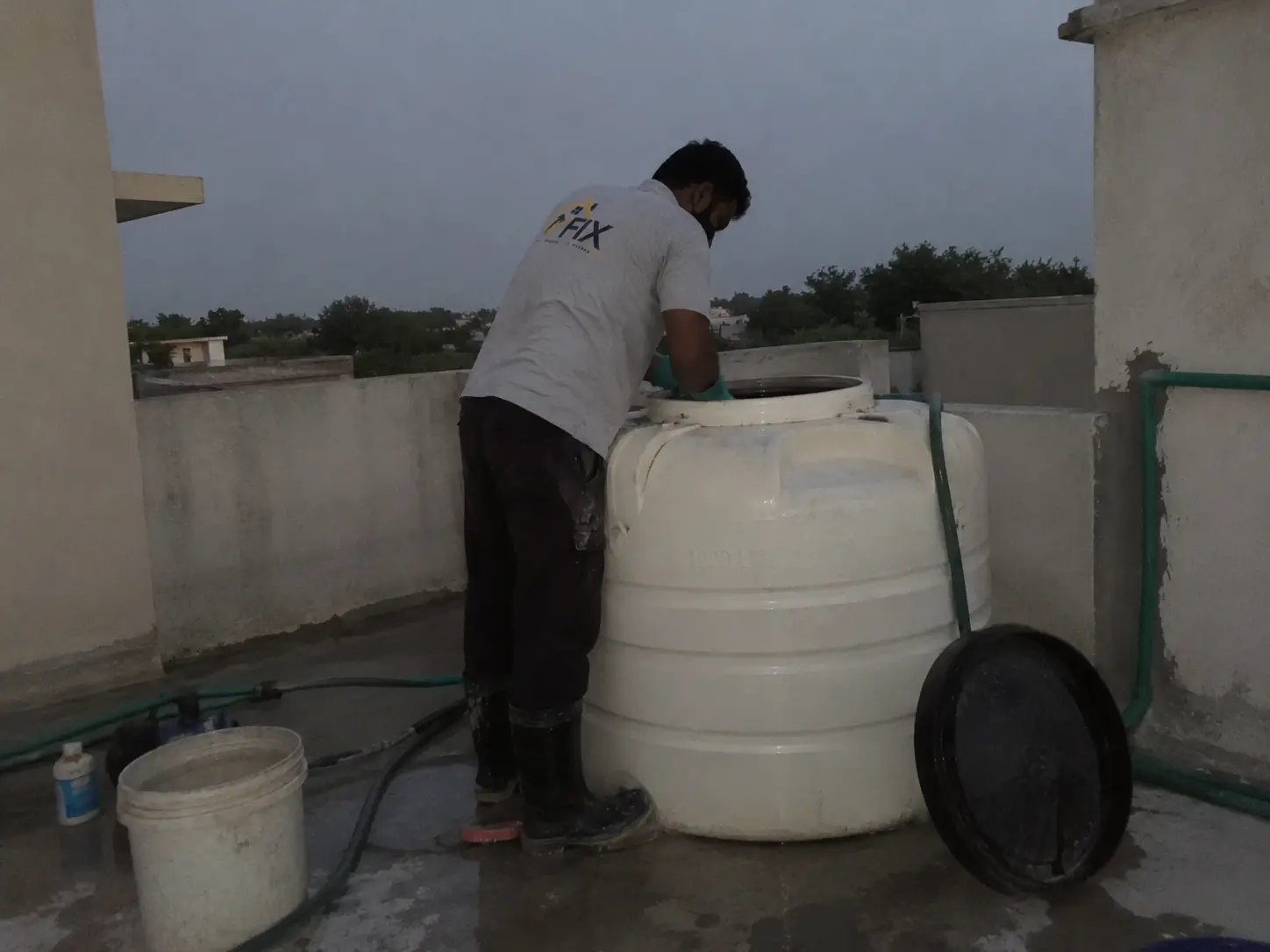
Heat, dust and standing water. Dubai delivers all three.
Heat. DM’s own planning figures put the average summer outdoor temperature at 42°C and residents have complained for years that water from overhead tanks turns scalding hot . That matters because Legionella thrives in stagnant water between about 20°C and 45°C (The National). A tank in summer sun spends weeks in that range.
Dust. Fine sand slips through lid gaps and open vents, settles on the bottom and builds a sludge layer. That sludge clogs valves and pumps and turns the water murky. A badly closed cover also lets in insects and dirt, as one cleaning-company director told Gulf News.
Sunlight. Light through a cracked or thinning lid feeds algae.
Standing water. Every week your villa sits empty, the tank holds the same water. If a tank hasn’t been used for more than a month, add a clean to your checklist.
Storms and floods. After heavy rain, floodwater can reach tanks. Follow your building’s instructions if management reports possible contamination.
Start with what you can’t see.
Sediment settles on the base, because water leaves from higher up. Flushing your taps never removes it. Only draining and scrubbing does.
Biofilm is the slimy layer that coats tank walls. It can shelter other microbes, including bacteria such as Salmonella and E. coli, according to a review in the Journal of Pure and Applied Microbiology. The same study isolated Pseudomonas bacteria from drinking-water tanks in Saudi Arabia. DM’s central laboratory tests water for E. coli and Legionella (DM accreditation scope).
Legionella is the serious one, and it’s an inhalation risk. Symptoms look like pneumonia: fever, chills, cough and muscle aches. Elderly people, smokers and anyone with a weakened immune system face the highest risk.
Reported cases in the Middle East are rare. Still, older reports in The National describe Legionella in Dubai home water, including a villa in Al Barsha. Those samples came from households with unexplained health complaints and from dental clinics, so they prove the bacteria can settle into villa systems. They don’t tell you how common it is. Another report traced heavy contamination in a Palm Jumeirah villa to a cracked tank and a rusted paint drum left behind by builders.
Ask any Dubai expat group about hair fall and the tap water takes the blame. The evidence is more mixed than the forums suggest.
A hair specialist told The National there’s no scientific way tap water causes hair loss, and that many newcomers lose hair during their first 12 to 18 months for other reasons. Chlorine, though, can dry out skin and hair.
Where does your tank fit in? A dirty tank can add contamination and irritants on top. Gulf News once reported tenants in an Al Barsha building who developed skin irritation after hydraulic oil dripped into their rooftop tank. That’s an extreme case, not the norm.
So here’s the honest version. A clean tank can’t promise you thicker hair. It does remove one variable, and it costs less than most shower filters and hair treatments. If your skin or scalp problems continue afterwards, see a dermatologist.
Brown water the day you return from holiday? Run the taps for a few minutes first. If it doesn’t clear, assume sediment and book a clean.
And remember, a tank can need cleaning with none of these signs showing. That’s why the six-month schedule beats waiting for symptoms.
| Tank type | What to look for | Ask the cleaner |
|---|---|---|
| Rooftop (GRP or plastic) | Sun damage, lid gaps, cracks | Will you check that the lid is sealed and the vent screened before refilling? |
| Ground-level | Dust and debris getting in, overflow and vent screens | Will you check the screens and the float valve? |
| Underground (sump or concrete) | Hidden cracks, silt, hatch seal | How do you enter safely (gas testing, a standby person outside the hatch)? |
DM’s tank guidelines cover insulation, ventilation, float valves and leak prevention. A cleaning visit is the perfect moment to check all four.
Five-minute self-check: Does the lid fit tightly? Does fine mesh cover the vent? Does the float valve shut the water off properly? Do you see any crack or leak? Does light reach the water?
A typical villa tank takes two to four hours. You won’t have water from the tank while the crew works, so plan showers and laundry around the booking.
Red flags: nobody drains the tank fully, the crew only hoses it down, nobody scrubs, you get no certificate or lab result, the company can’t show DM approval, an underground job has no safe-entry method, or the price sits far below the market range with no explanation.
Most standard villa tanks land between AED 500 and AED 1,200. Large, rooftop or underground tanks can reach AED 1,500.
| Source | Published figure | Note |
|---|---|---|
| ServiceMarket | AED 699 per tank | Includes equipment and cleaning agents; its cost guide lists this as excluding VAT |
| Dubizzle | From AED 499 for small residential tanks; AED 700–1,200 for larger rooftop or underground tanks | Starting prices |
| Real Estate Club Dubai | AED 600–1,500 per villa clean | Described as including disinfection and a certificate |
| The National (2020) | AED 500–1,500 per year | Older villa-running-cost estimate |
Some roundups list AED 149–350. Check exactly what that price includes before you say yes. We checked these figures in October 2026, so confirm with a current quote.
What moves the price: the number and size of tanks, access (rooftop ladder or underground hatch), how much sludge has built up, whether the lab test and certificate are included, VAT, and urgency.
Yearly budget: two cleans at AED 500–1,500 each means roughly AED 1,000–3,000 per tank per year.
Contact Villafix today to avail of special customer discounts.
Under DM guidelines, landlords are accountable for the cleanliness of water storage tanks. Tenants can ask for water-testing records, cleaning records and before-and-after photos. Some contractors describe it differently and say the owner or tenant must arrange the cleaning, so read your tenancy contract and put your request in writing.
Copy-paste message to your landlord:
Hello [Name], could you please share the date of the last water tank cleaning at [villa address], the cleaning certificate, and the post-cleaning lab result? Dubai Municipality advises cleaning every six months with an approved company. If there is no record from the last six months, could you arrange a cleaning and confirm the date? Thank you.
If your landlord stalls and you decide to pay for the clean yourself, agree on reimbursement in writing first. Then keep the invoice, certificate and lab report.
A clean tank doesn’t finish the job. DM’s advice covers tanks and plumbing systems, so ask whether pipeline disinfection comes with your quote.
Watch your water heater, too. WHO guidance for hotels, homes and similar buildings suggests keeping hot water above 50°C and cold water below 20°C where possible, and flushing unused taps weekly. DM’s circular on solar water heaters cites 60°C for hot water storage, taken from its Legionella control guidelines. Mind the scald risk if children live at home.
We don’t recommend it. Entering a tank is a confined-space risk. The disinfectant has to be the right product at the right strength for water you’ll use. And the guidance expects a licensed company. A DIY job also leaves you with no certificate or lab record to show a landlord, tenant or buyer.
| Date cleaned | Company (DM-approved?) | Tanks cleaned | Certificate no. | Lab result date | Next due |
|---|---|---|---|---|---|
How often should a villa water tank be cleaned in Dubai?
At least every six months. Dubai Municipality advises residents to clean and disinfect water tanks and plumbing systems twice a year using a DM-approved company. Clean sooner after long absences, before moving into a new villa, or if your water turns cloudy, smelly or brown.
Is villa water tank cleaning mandatory in Dubai?
DM’s public wording for homes is advice, but only licensed companies may do the work, and DM’s guidelines hold landlords accountable for tank cleanliness. We found no published fine for private villas, so confirm with DM before relying on any penalty figure.
How much does villa water tank cleaning cost in Dubai?
Most standard villa tanks cost AED 500–1,200 in 2026. Large, rooftop or underground tanks can reach AED 1,500. Price depends on size, access and whether the lab test and certificate come included. Two cleans a year cost roughly AED 1,000–3,000 per tank.
How long does it take, and will I lose water?
A typical villa tank takes two to four hours. Tank water isn’t available while the crew drains, scrubs, disinfects and refills it, so plan showers and laundry around the booking.
Who is responsible for the tank in a rented villa?
Under DM guidelines the landlord is accountable for tank cleanliness. Ask for the last cleaning date, certificate, lab result and before-and-after photos, and check your tenancy contract for anything that says otherwise.
How do I know a company is DM-approved?
Ask for its DM approval, then check the approved list of cleaning and disinfection companies on dm.gov.ae. A proper job ends with a certificate, lab results and before-and-after photos.
Can a dirty tank cause hair fall or skin irritation?
Possibly as one factor, but the evidence is thin. A hair specialist told The National tap water can’t cause hair loss, and chlorine can dry skin and hair. A dirty tank can add irritants. Clean it first, then see a dermatologist if symptoms continue.
Why is my water brown after summer?
Water that sat in tanks and pipes all summer picks up sediment and rust particles. Run the taps for a few minutes. If it stays brown, cloudy or smelly, book a clean with a DM-approved company and ask for a lab test.
Does cleaning the tank remove the Legionella risk?
It removes the sediment and biofilm that feed bacteria, but pipework, water heaters and unused taps matter too. WHO guidance includes keeping hot water above 50°C, cold water below 20°C where possible, and flushing unused taps weekly.
Can I drink the water right after cleaning?
Follow your contractor’s advice. A proper job ends with a rinse until residual chlorine is back to safe drinking-water levels, plus a lab sample. Ask when results will be ready, and run the taps until the water runs clear.
Call or Whatsapp Villafix for your Water tank cleaning services. We available 24/7 with free site visit.